

Leaving a Legacy Starts Long Before the Will Is Read
Leaving a Legacy Starts Long Before the Will Is Read: Insights from Johann Kurtz’s Leaving a Legacy
At WealthWise Financial Group, conversations with clients often turn to legacy. What will endure after you are gone? How will your life’s work, values, and resources shape the next generation—and the one after that? Many people assume legacy begins with estate documents, trusts, or charitable bequests. Yet the most lasting legacies are forged much earlier: in the daily work of raising children who are prepared to receive, steward, and extend what has been entrusted to them.
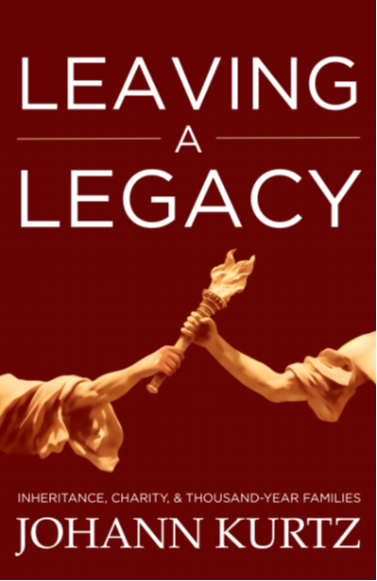
Johann Kurtz’s book Leaving a Legacy: Inheritance, Charity, & Thousand-Year Families offers a timely and thoughtful exploration of precisely this truth. Written amid what has been described as the largest generational wealth transfer in history—as baby boomers and older generations prepare to transfer trillions of dollars in—Kurtz challenges the modern tendency to view inheritance with suspicion.[1] Should wealth go primarily to children, or to impersonal charities? Does leaving resources to family risk spoiling them? How does one defend the preferential love of one’s own kin in an age that prizes abstract meritocracy?
Kurtz reconnects readers with the older Western and Christian understanding of inheritance as a moral duty and a multi-generational project. True charity, he argues, is not primarily the distant, bureaucratic philanthropy of large foundations. It is the ordered love of neighbor that begins closest to home—family, community, and the tangible good one can do across generations. Virtuous families, sustained over time, become the indispensable guardians of that enduring good. The book weaves philosophy, theology, history, and practical counsel, drawing on the examples of long-lasting dynasties and the cautionary tales of those that dissipated.
Legacy Begins in the Home
A central insight of Leaving a Legacy—and one that resonates deeply with the counsel we offer clients—is that leaving a meaningful inheritance starts well before life ends. Wealth alone is insufficient and can even become a liability if the next generation lacks the character, discipline, identity, and sense of duty required to steward it wisely. Kurtz contends that the modern impulse to disinherit children “for their own good,” or to redirect everything to charity out of fear of spoiling them, often reflects a prior failure: the failure to form children worthy of the responsibility.
In the book’s chapters devoted to child-rearing (including material related to his earlier essay “Raising Children Worthy of Empires”), Kurtz outlines concrete, time-tested practices drawn from families that have successfully transmitted both resources and virtue across centuries. These are not formulas for producing perfection, but deliberate habits that equip the young to carry a family’s mission forward.
First, never neglect the ordinary practices and rituals of raising healthy children. Presence, shared meals, play, conversation, physical activity, adventure, and the steady rhythms of family life form the foundation. Exceptional outcomes rest on ordinary goods done consistently. Aristocratic or long-enduring families do not abandon these basics in pursuit of elite credentials; they build upon them.
Second, cultivate a strong family faith and a clear understanding of both duties and privileges. Wealth and status cannot purchase certain goods—integrity, resilience, or a clear conscience—nor can they shield one from moral accountability. Children who know they are accountable to something higher than themselves (God, family honor, community obligation) are far better prepared to handle advantage without corruption. Faith and duty orient privilege toward service rather than self-indulgence.
Third, deliberately impress upon children the family’s identity, mission, and values. A sense of belonging to a story larger than the individual self counters the modern drift toward rootlessness and meaninglessness. When young people understand “who we are,” “what we stand for,” and the responsibilities that accompany their place in the family, inheritance ceases to feel like an unearned windfall and becomes a trust to be honored.
Fourth, initiate children into structures that extend beyond the nuclear family. This includes gradual assumption of real responsibility (in a family business, estate, or community efforts), exposure to exemplary adults outside the immediate household, and participation in wider networks of trust and mutual obligation. Succession is not a sudden handover at death; it is a long apprenticeship. Responsibility is layered on early and increased over time so that by the point of formal transition, the next generation already knows how to lead.
Kurtz also emphasizes practical estate design that supports these aims: favoring assets that encourage stewardship (family enterprises, real property, or other less-liquid holdings that require care and long-term thinking) over pure liquid cash that tempts rapid consumption. The goal is not merely to transfer balance sheets, but to transmit a way of life.
What This Means for Clients Today
These ideas align closely with the conversations we have at WealthWise. Effective legacy planning is never only about tax efficiency, asset allocation, or the mechanics of trusts and wills—though those tools matter. It is about aligning financial structures with the human reality of family formation. When clients invest time and intentionality in raising children who understand duty, identity, and service, the wealth transfer becomes an act of continuity rather than a potential source of conflict or dissipation.
We encourage clients to consider questions such as:
- How are family values and a sense of shared mission being communicated day to day?
- Are the rising generation being given meaningful responsibility and exposure to the family’s work or community commitments?
- Does the estate plan create incentives for long-term stewardship rather than short-term consumption?
- How might local, relationship-based giving and community involvement reinforce the habits of ordered charity that Kurtz describes?
Leaving a Legacy does not pretend that every family will endure for a thousand years. It does insist that the attempt itself—raising the next generation with clarity, discipline, faith, and a sense of higher purpose—is already a profound act of legacy. The spiritual and formational work precedes and enables the financial transfer.
If you are reflecting on what your own legacy might look like, we invite you to read Johann Kurtz’s book and then sit down with us. Together we can explore how your financial plan, estate design, and family practices can work in concert—so that what you leave behind is not merely resources, but people prepared to use them well for generations to come.
Legacy is not something that happens only at the end. It is being written, every day, in the lives of those who will carry it forward.
[1] Lichtenber, N (2025, July 23). The $124 Trillion Great Wealth Transfer is bigger than ever-and millennials will get the biggest cut. Fortune.
Quentin Davis is a Registered Representative and Investment Adviser Representative of, and securities and investment advisory services are offered solely by, Equity Services, Inc., Member FINRA/SIPC, 100 E. Campus View Blvd., Suite 125, Columbus, OH 43235, 614-430-8414. WealthWise Financial Group is independent of Equity Services, Inc. In MO, Equity Services, Inc. operates as Vermont Equity Services, Inc.Equity Services, Inc. and its representative do not offer tax or legal advice. For advice concerning your own situation, please consult with your appropriate professional advisor.
Leaving a Legacy and its author are not affiliated with Equity Services, Inc. or WealthWise Financial Group. Neither Equity Services, Inc. WealthWise Financial Group, Nor Quentin Davis receives compensation in connection with the promotion or sale of this book. References to the book are provided for informational purposes only and should not be construed as an endorsement of all views, opinions, or recommendations expressed by the author. The author’s views are his own and do not necessarily reflect those of Equity Services, Inc. or WealthWise Financial Group. TC9094159(0926)1